
Stellest 2.0 (HALT Max): What the Latest Research Means for Myopia Control
A 2025 randomized crossover clinical trial tested an enhanced lenslet design (HALT Max) and reported slower axial length elongation compared to the original HALT design used in Essilor Stellest lenses. Here is what the results actually mean and what parents should do next.
Details- Published: February 16, 2026
- Author: Dr. Harina Thyriar, Optometrist (Certified in Ocular Pathology)
- Focus: Myopia Control, Pediatric Eye Care
- Location: Mont-Royal, Québec

Stellest 2.0 for Myopia Management
Myopia is not just about stronger glasses every year. It is about controlling how fast the eye grows. The new Essilor Stellest 2.0, using H.A.L.T. MAX technology, was developed to slow eye growth more effectively than the previous generation.

Stellest 2.0 is available at HARINA Optométristes for children who require evidence-based myopia management.
What Is Stellest 2.0?
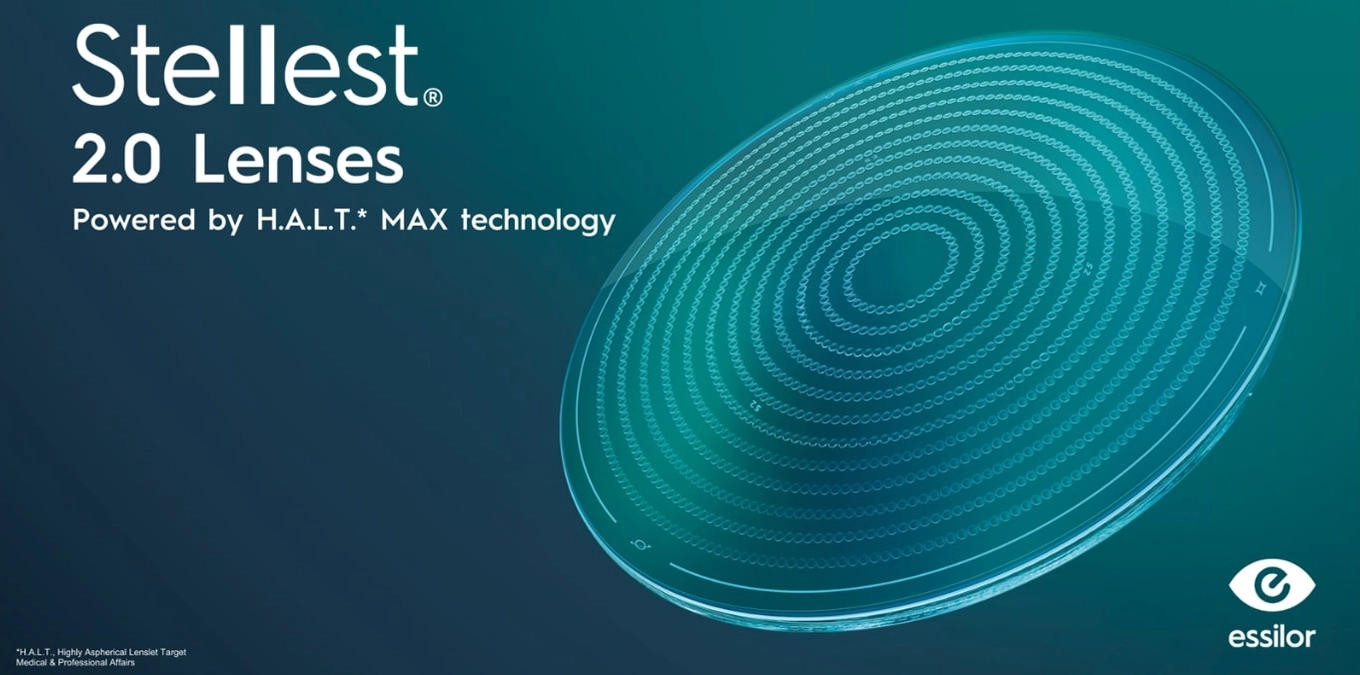
Stellest 2.0 is the next evolution of Essilor’s Highly Aspherical Lenslet Target (H.A.L.T.) technology.
The original Stellest lenses use a ring of highly aspherical lenslets to create a special optical signal in front of the retina. This signal helps slow axial elongation, which is the physical growth of the eye that drives myopia progression.
Stellest 2.0 (H.A.L.T. MAX) increases the power and asphericity of these lenslets to enhance that signal.
Why Controlling Axial Length Matters
When a child becomes more myopic, it is because the eye is growing longer. The longer the eye becomes, the higher the lifetime risk of:
- Retinal detachment
- Myopic macular degeneration
- Glaucoma
- Early cataracts
Modern myopia management focuses on slowing that eye growth, not just updating the prescription.
How Is Stellest 2.0 Different From the Previous Generation?
| Feature | Stellest (H.A.L.T.) | Stellest 2.0 (H.A.L.T. MAX) |
|---|---|---|
| Lenslet design | Highly aspherical | Increased power & asphericity |
| Optical signal strength | Strong | Enhanced |
| Volume of non-focused light (VoNFL) | Broader than standard lenses | Even broader and positioned further forward |
| Target | Slow axial elongation | Further reduce axial elongation |
The updated design creates a wider and more anterior “volume of non-focused light,” which is believed to provide a stronger myopia control signal to the retina.
What Did the Clinical Study Show?
A 2025 randomized crossover clinical trial compared the original H.A.L.T. lenses with the enhanced H.A.L.T. MAX design in children aged 6 to 10 years.
- Children wearing H.A.L.T. MAX lenses showed significantly less axial elongation over 6 months.
- The cumulative 1-year difference was approximately 0.10 mm less eye growth compared to the previous generation.
- Younger children and faster progressors showed even greater benefit.
In myopia management, even a reduction of 0.10 mm per year is clinically meaningful.

Who May Benefit Most From Stellest 2.0?
Stellest 2.0 may be especially beneficial for:- Children under age 9
- Children whose prescription is increasing rapidly each year
- Children with a strong family history of high myopia
- Children already wearing Stellest who continue to progress
Is Stellest 2.0 Safe?
In clinical testing:
- No significant binocular vision changes were reported
- Most children adapted within a few days
- No device-related adverse events were reported
How Your Child Can Get Stellest 2.0 at HARINA Optométristes
We begin with a comprehensive pediatric eye examination and myopia assessment. During the consultation, we:
- Evaluate progression trends
- Assess risk factors
- Discuss lifestyle influences
- Review all evidence-based treatment options
If Stellest 2.0 is appropriate, we will custom order the lenses and provide follow-up monitoring to track progression.
Book a Myopia Control Consultation

Myopia Control Is a Long-Term Plan
Myopia control is not about selling a lens. It is about protecting your child’s long-term retinal health.
Stellest 2.0 represents an advancement in optical technology. What matters most is early detection, consistent monitoring, and choosing the right strategy at the right time.
Frequently Asked Questions About Stellest 2.0 at HARINA Optométristes
Stellest 2.0 is an updated myopia control lens design from Essilor that uses an enhanced lenslet system (H.A.L.T. MAX). It was developed to strengthen the myopia control signal compared to the previous Stellest generation.
Yes. Stellest 2.0 is now available at HARINA Optométristes in Mont-Royal. A proper assessment is required to confirm whether it is appropriate for your child.
Both designs aim to slow myopia progression by slowing axial elongation (eye growth). Stellest 2.0 increases the power and asphericity of the lenslets compared to the original Stellest design, which may enhance the myopia control signal.
Stellest lenses include a central zone for clear distance vision and a surrounding lenslet structure designed to create a specific optical signal in front of the retina. This signal is intended to influence eye growth and slow axial elongation.
A 2025 clinical trial comparing lens designs reported significantly less axial elongation with the enhanced H.A.L.T. MAX design versus standard H.A.L.T. Results vary by child, and the best option depends on age, progression rate, and risk factors.
Children may benefit most if they are younger, progressing quickly, have a strong family history of myopia, or show clear year-to-year prescription changes. The recommendation depends on a full clinical assessment.
Myopia control strategies are commonly considered for school-age children, especially when myopia is progressing. During your child’s exam, we determine the best strategy based on age, prescription, progression pattern, and ocular health.
No treatment can promise to stop myopia completely. The goal is to slow progression and reduce the chance of developing high myopia. Results vary, which is why monitoring and follow-up matter.
Myopia management is monitored over time. We track progression trends across follow-up visits. The goal is to reduce the rate of change, not to expect an immediate short-term “fix.”
Stellest lenses are spectacle lenses, which many families prefer because they are non-invasive. Adaptation varies by child. We guide your family on what to expect and we monitor outcomes over time.
Yes. The lens includes a clear central zone for distance vision. Most children adapt quickly. If your child is sensitive initially, we provide guidance to make adaptation smoother.
Consistent daily wear matters. We will give clear recommendations based on your child’s lifestyle and progression pattern. The goal is stable, routine wear during waking hours.
Yes, in many cases. If your child is still progressing on the previous generation, Stellest 2.0 may be considered. We confirm candidacy based on examination findings and progression trends.
Book a pediatric eye exam or myopia assessment. If Stellest 2.0 is appropriate, we will take measurements, place the lens order, fit the lenses properly, and schedule follow-up visits to monitor progression.
Daily habits matter. Outdoor time, limiting prolonged near work, and taking regular breaks can support myopia management. We provide realistic recommendations tailored to your child’s routine.
References
The resources below include the primary peer-reviewed study discussed in this article and additional high-quality sources on myopia control outcomes and clinical relevance of axial length.
-
Primary Clinical Trial (HALT vs HALT Max):
Nallour Raveendran RN, Ong WS, Wong YL, et al. Effect of Increased Power and Asphericity of Highly Aspherical Lenslets on Myopia Control Efficacy: A Contralateral Crossover Study. Translational Vision Science & Technology. 2025;14(11):9. DOI: 10.1167/tvst.14.11.9 -
Aspherical lenslets efficacy (1-year data):
Bao J, Yang A, Huang Y, et al. One-year myopia control efficacy of spectacle lenses with aspherical lenslets. Br J Ophthalmol. 2022;106(8):1171–1176. -
Aspherical lenslets vs single-vision (randomized trial):
Bao J, Huang Y, Li X, et al. Spectacle lenses with aspherical lenslets for myopia control vs single-vision spectacle lenses. JAMA Ophthalmol. 2022;140(5):472–478. -
Why axial length is a preferred outcome:
Brennan NA, Toubouti YM, Cheng X, Bullimore MA. Efficacy in myopia control. Prog Retin Eye Res. 2021;83:100923. -
Global consensus guidance (IMI):
International Myopia Institute (IMI) reports on myopia risks, interventions, and outcomes. Available from: iovs.arvojournals.org
Help Your Child Stay Ahead of Myopia Progression
Most parents only notice myopia when the prescription jumps again. By then, the eye has already grown. Myopia management is about slowing that eye growth early, so your child has a better chance of avoiding high myopia and the long-term risks that come with it.
Stellest 2.0 is now available at HARINA Optométristes. If your child is progressing quickly, is under 9, or has a strong family history of myopia, we can evaluate whether Stellest 2.0 is a good fit and build a clear plan with proper follow-up monitoring.
What you get at HARINA Optométristes
- A comprehensive pediatric eye examination and myopia progression assessment
- Evidence-based discussion of options, including Stellest 2.0 when appropriate
- Precision measurements and a clear follow-up schedule
- A plan focused on long-term eye health, not just “stronger glasses”